Understand and communicate
Work with language, summarize long documents, translate text, brainstorm ideas and prepare explanations for different audiences.
Curious about artificial intelligence? Wondering whether AI will change your career, business, studies or everyday life? You are in the right place.
Discover how AI evolved, what it can do, where it falls short, and how you can use it to learn faster, think more creatively and turn ideas into action.
The opportunity lies not only in what machines can do, but in what people can achieve with them.
Artificial intelligence (AI), or 人工智能, is a field of technology concerned with building computer systems that can perform tasks associated with human intelligence. These tasks can include recognizing patterns, understanding language, making predictions, supporting decisions and generating text, images, audio or computer code. AI systems differ in their capabilities, and they do not automatically understand the world as people do.
AI is not one single machine or application. It is a broad collection of methods and tools that can help people solve different kinds of problems.
Work with language, summarize long documents, translate text, brainstorm ideas and prepare explanations for different audiences.
Analyze information, identify trends, support forecasting and help researchers investigate questions that would otherwise take much longer to explore.
Develop drafts, images, software prototypes, designs, learning materials and alternative approaches to creative challenges.
Support biomedical research, explore biological data, assist medical-image analysis and help researchers develop and test scientific hypotheses.
Explore customer needs, improve selected workflows, develop service ideas and support decisions with better-organized information.
Help analyze environmental information, support accessibility, improve resource planning and explore solutions to complex problems.
Artificial Intelligence and Intelligence Augmentation offer complementary ways of thinking about technology. One focuses on what intelligent systems can perform; the other emphasizes how technology can extend human abilities.
Build or use computer systems that perform tasks such as recognizing patterns, generating content, making predictions and assisting with decisions.
Ask: What can the system help accomplish?
Use technology to extend human capabilities, improve understanding, explore possibilities and make better informed decisions.
Ask: How can this help people do more?
“As technology advances so rapidly, we should take the advances as a multiplicative agent, not replacement agent.”
A human-centred technology perspective.
Today's AI did not appear overnight. Its story spans decades of scientific ideas, computer development, data collection, statistical analysis, advances in computing and increasingly capable learning systems.
The Dartmouth Summer Research Project on Artificial Intelligence, held at Dartmouth College in Hanover, New Hampshire, helped establish AI as a distinct field of research. Scientists explored whether aspects of learning and intelligence could be represented in machines.
Explore: Dartmouth's history of AI .
Researchers developed systems that used explicit rules, logical reasoning and specialized knowledge to tackle selected problems. Progress was important, but computing power and practical limitations restricted what these systems could achieve.
As digital information and computing became more widely available, data collection and statistical analysis became increasingly important. Researchers and organizations could use data to discover patterns, test predictions and support decisions.
The growth of the internet, digital services, connected devices and large-scale computing created new opportunities to analyze vast quantities of information. Machine learning increasingly benefited from larger datasets and improved computing resources.
Advances in neural networks, training methods, specialized computing and access to data improved performance in tasks such as image recognition, speech processing and language technology.
Open data, open research and open-source tools also helped researchers and developers share knowledge and build on one another's work.
The transformer architecture introduced in 2017 became a major milestone in modern AI. GPT research followed in 2018, helping establish a path toward generative language systems that can produce and work with human-readable text.
This period is especially relevant to Dr. Hwa A. Lim's early public discussion of AI in 2018.
Large language models and accessible conversational AI tools made it easier for people without specialist technical training to experiment with AI for writing, research, coding, learning and creative work.
The focus increasingly includes AI-assisted workflows, multimodal systems that work across different kinds of information, reasoning and coding capabilities, evaluation, governance and responsible deployment. Capabilities vary by system, and progress does not eliminate errors or the need for human oversight.
Further reading: Stanford HAI, 2026 AI Index Report .
AI is not just a story about increasingly intelligent machines. It is also a story about data, computing, human creativity, scientific collaboration and the changing ways people turn information into useful action.
You do not have to follow the same path as everyone else. Start with your interests, your existing strengths and the problems you want to solve.
You do not need a perfect academic history to begin exploring AI. Start with free learning resources, small experiments and practical projects that demonstrate what you can do.
First project: Create a simple AI-assisted study guide or personal portfolio.
Find a starting point →Explore customer needs, test business ideas, organize research, prototype services and identify repetitive tasks that may benefit from carefully chosen AI tools.
First project: Use AI to research a real customer problem and evaluate possible solutions.
Explore practical applications →Use AI to explore ideas, prepare first drafts, improve workflows and experiment with new services while retaining your own voice and quality standards.
First project: Design an AI-assisted workflow for one task you perform regularly.
Discover useful skills →Combine AI literacy with your own discipline: business, engineering, biology, design, education, humanities, computing or another field you care about.
First project: Investigate how AI could help address a real problem in your field.
Build your learning roadmap →Learn about data preparation, literature discovery, statistical methods, machine learning and the responsible use of AI in research.
First project: Reproduce a small experiment using a public dataset and document your methods.
Explore AI research →Bring your industry knowledge to AI. Your experience can help you identify meaningful problems, assess outputs and recognize where automated solutions need human judgment.
First project: Map one existing workflow and assess where AI could help.
Turn experience into an advantage →Remember: AI can create opportunities, but no course, tool or qualification guarantees a job or business success. Practical skills, judgment, persistence and the ability to demonstrate results matter.
You can begin learning about AI today. You do not need to master every concept before trying your first project. Progress from understanding to experimentation, then from experimentation to demonstrable skills.
Learn what AI, machine learning, generative AI, data and human oversight mean in everyday language.
Goal: Explain AI clearly to another person.
Try an AI tool with a real task. Compare its answer with your own thinking and verify important claims.
Goal: Understand what works and what fails.
Create something useful: a research summary, a business prototype, a data visualization, a learning aid or a simple application.
Goal: Produce evidence of a practical skill.
Document your process, invite feedback, improve the result and explain how you checked its quality.
Goal: Build a credible portfolio of work.
Start with communication, research, problem-solving, critical thinking and an understanding of the limitations of AI-generated results.
Explore AI resources from NIST →Progress toward programming, mathematics, statistics, data preparation, model evaluation and responsible software development.
Explore AI learning resources →AI can produce useful results quickly, but speed is not the same as accuracy. Treat its output as something to evaluate, not something to accept automatically.
For a structured approach to AI risk and responsible use, consult the NIST AI Risk Management Framework .
Exploring AI is not only about understanding the technology. It is also about understanding how people can use technology to expand their capabilities, create opportunities and address real-world problems.

Explore Dr. Lim's background: Dr. Hwa A. Lim's profile .
Dr. Hwa A. Lim's professional connection with Silicon Valley placed him close to an important centre of technology development. His perspective brings together an interest in technological progress, data, AI and the ways people can put new capabilities to practical use.
In 2018, he delivered a lecture titled “Big, Open Q&A, AI in Health and Wealth” at the International Conference for Managing the Asian Century, Linking the Belt & Road with Smart Biotech, in Xiamen, China, on July 6–7, 2018.
This early public discussion of AI's relevance to health, wealth and changing skill requirements provides a useful historical perspective on the technology's expanding reach.
“We are trained to think of skills as something we develop for the workplace. But think of them as strengths, and they open up a huge number of opportunities. Learning AI, just like any new disruptive technologies, is an example.”
— Dr. Hwa A. Lim, “Big, Open Q&A, AI in Health and Wealth,” Xiamen, China, July 6–7, 2018.
“I do not believe in ghosts, therefore I do not ghost-write. I believe in AI, but still I do not AI-write. I do, however, smart-write with AI.”
— Dr. Hwa A. Lim, from one of his books.
The idea is simple: technology can support our thinking without replacing our responsibility for the final result. Whether you are writing, researching, creating or running a business, use AI to extend your capabilities while keeping your own judgment, knowledge and voice.
Editorial note: Add the exact book title and publication details when verified.
Use this gallery to showcase Dr. Lim's AI lectures, technology discussions and related activities. The following photographs are selected from the supplied D'Trends PhotoGPT directory.
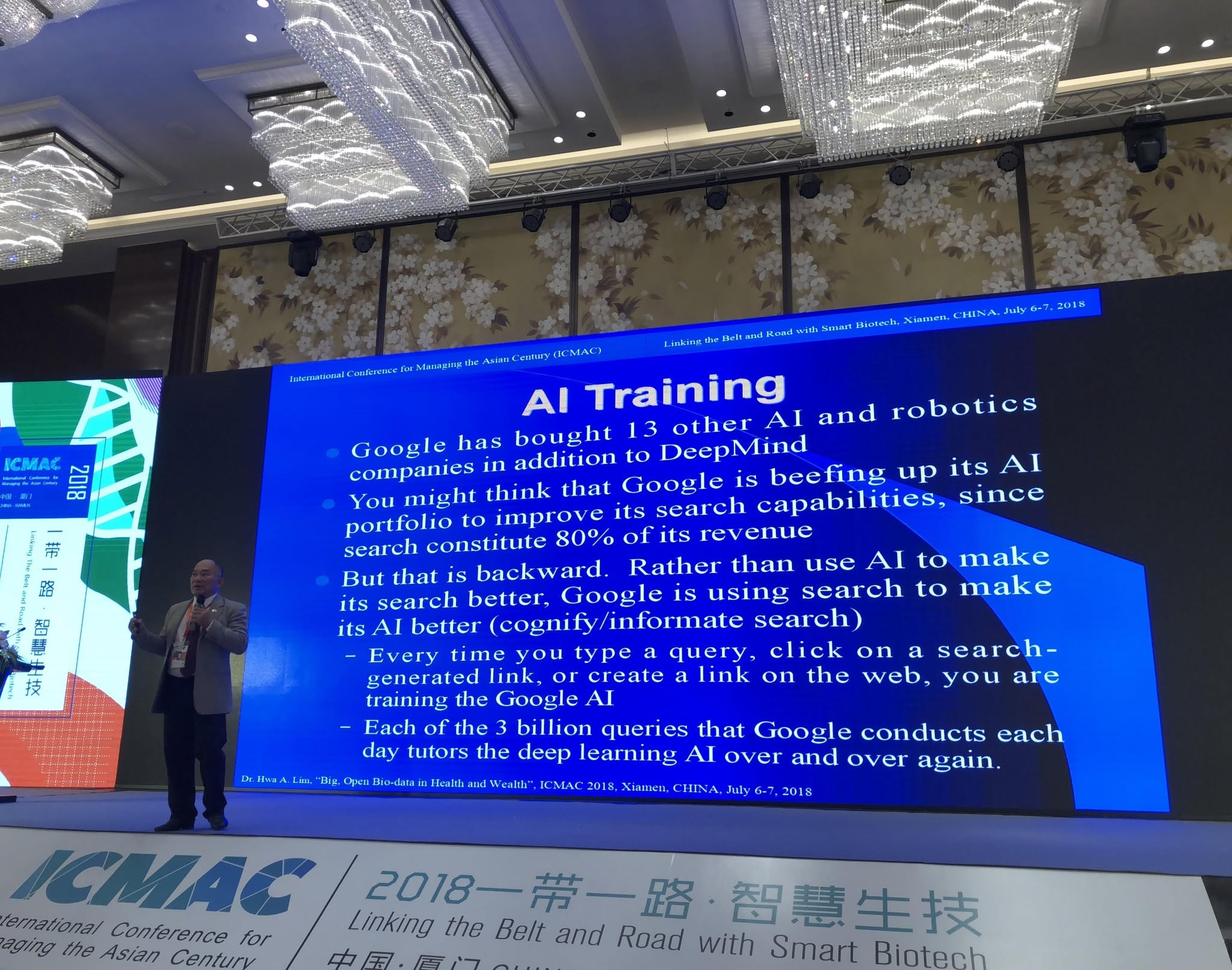
PHOTO LEGEND:
Dr. Hwa A. Lim presented a keynote
"Big, Open Bio-data in Health and Wealth",
Intl Conference for Managing the Asian Century (ICMAC), Linking the Belt & Road with Smart Biotech, Xiamen, CHINA, July 6, 2018.
The following day (July 7) he was a speaker on
"Big, Open Q&A, AI in Health and Wealth".
This was after the advent of GPT in 2017, and he touched on AI's
potential impacts.
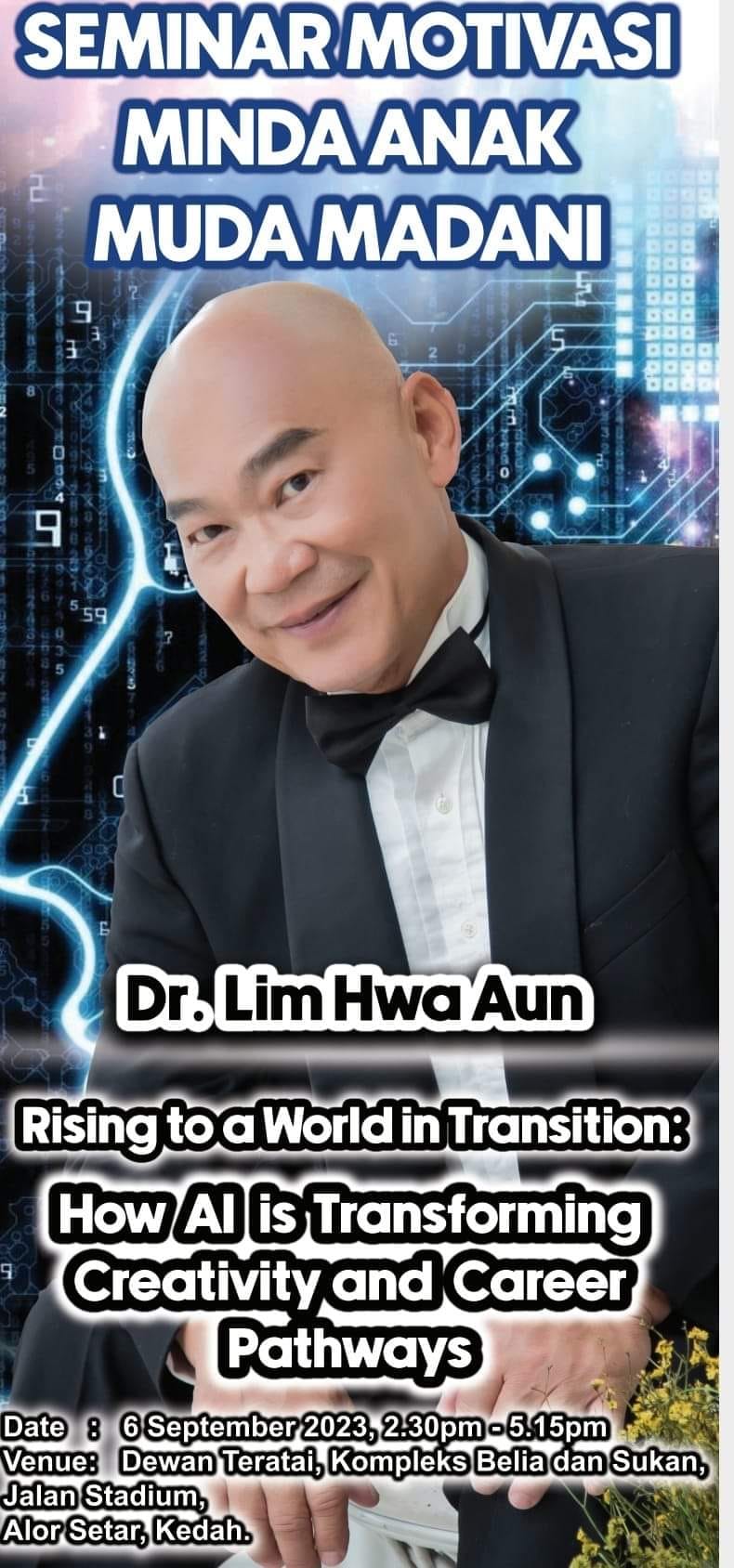
PHOTO LEGEND:
Dr. Hwa A. Lim presented an AI lecture series:
- Ministry of Youth, MADANI Lecture, "Rising to a World in Transition: How AI is Transforming Creativity & Career Pathways", Dewan Teratai, Kompleks Belia dan Sukan, Jalan Stadium, Alor Setar, Kedah, Malaysia, August 5, 2023.
- Special Lecture, "AI: Narrowing the Gap Between |Awareness & Action|", Dewan Dato Teoh Boon Beng, SMJK Keat Hwa, Jalan Kuala Kedah, 05400 Alor Setar, Kedah, Malaysia, October 19, 2023.
- Special Lecture, "AI Versus IA: Artificial Intelligence versus Intelligence Augmentation", Dewan Dato Lee Seng Cheng, Keat Hwa High School, Jalan Teratai Off Jalan Pegawai, 05050 Alor Setar, Kedah, Malaysia, Nov 14, 2023.

PHOTO LEGEND: Dr. Hwa A. Lim @ a TV live interview after his
lecture @ the
Main Forum, "AI: An enabled enabler in healthcare & biotechnology", @ Advancing Biotechnology & Healthcare Collaboration towards a China-Malaysia Community with a Shared Future, Malaysia-China Economic Cooperation Outlook Forum 2026, Mandarin Oriental Hotel, Kuala Lumpur City Center (KLCC), May 21, 2026 Thursday.
Browse the complete D'Trends PhotoGPT directory to choose additional images. Confirm image rights, accuracy, relevance and caption details before publication.
AI connects computer science with business, biology, education, creativity and society. Follow your curiosity and explore the subject from different angles.
Explore ideas, perspectives and explanations related to AI and Intelligence Augmentation.
Browse AI & IA resources →Explore talks about AI, changing career pathways, creativity and the relationship between AI and IA.
Find lecture materials →Continue learning through recorded presentations and discussions listed in the D'Trends resource hub.
Explore available videos →Investigate how AI and data analysis can support scientific questions, including research in biology and healthcare.
Discover bioinformatics →Explore AI organizations, technology developments and the wider ecosystem of research and applications.
Explore the AI resource hub →Consider how technology, information, data and AI can combine to create new capabilities and solve practical problems.
Visit D'Trends →New to AI? Start here. These short answers introduce important ideas without requiring a technical background.
Artificial intelligence is technology that enables computer systems to perform tasks associated with human intelligence. Depending on the system, these tasks can include recognizing patterns, understanding language, generating content and helping people analyze information.
No. People can begin using AI tools for writing, learning, brainstorming, research and other everyday tasks without knowing how to program. Building AI systems professionally, however, may require programming, mathematics, statistics and other technical skills.
AI can automate some tasks, change existing jobs and create demand for new capabilities. The impact varies by occupation, industry, organization and country. It is useful to learn which tasks in your field may change and how you can combine AI with your own knowledge, judgment and interpersonal skills.
They can explore business ideas, organize research, draft content, develop prototypes, analyze information and improve selected workflows. The best starting point is a real business problem, followed by a small experiment and a careful review of the results.
Generative AI refers to AI systems designed to produce new content, such as text, images, audio, video or code. Their output can be useful, but it can also be inaccurate, misleading, biased or unsuitable for the intended purpose.
AI, or Artificial Intelligence, focuses on systems that perform tasks associated with intelligence. IA, or Intelligence Augmentation, emphasizes how technology can extend human abilities. AI tools can be used in ways that support human augmentation.
The Dartmouth Summer Research Project on Artificial Intelligence, held in 1956, is widely recognized as a landmark in establishing AI as a distinct research field. It helped bring researchers together around the question of whether aspects of intelligence could be simulated by machines.
Begin by understanding the basic concepts, experiment with an accessible AI tool, verify its results and complete a small project related to your interests. If you want to develop AI systems, progress toward programming, mathematics, statistics and data skills.
No. AI systems can produce convincing but incorrect answers and may reflect biases or misunderstand context. Verify important information, especially when making medical, legal, financial, academic or other consequential decisions.
Start with a question. Explore a tool. Test an idea. Build something useful. As AI evolves, keep learning and make your human strengths part of the equation.